
INTRODUCTION
Here’s what keeps most people awake at night: the feeling that good opportunities only happen to “other people.”
You scroll through job boards and see postings that seem too good to be true. Security guard positions in Canada offering $18-26 CAD per hour, full housing coverage, airfare paid, and—wait for it—visa sponsorship included. So you think: There’s a catch. There must be. Nobody just hands out Canadian work permits to international workers anymore.
But here’s the truth that immigration consultants whisper about in quiet corners: In 2026, Canada is desperately short approximately 12,000+ security personnel across major cities—Toronto, Vancouver, Calgary, and Montreal. The demand is so acute that major employers have stopped waiting for local talent and started actively recruiting from overseas. And they’re not just offering jobs—they’re offering pathways.
This article is going to change how you think about your future.
Over the next 20 minutes, you’re going to discover:
✓ Real, active job postings you can apply to today (with direct links)
✓ Exactly what visa sponsorship means (no jargon, no bureaucratic nonsense)
✓ How much you’ll actually earn (not the inflated promises, the real money)
✓ A step-by-step roadmap to get hired, get sponsored, and get to Canada
✓ The 5 mistakes that instantly disqualify 73% of applicants (so you won’t make them)
By the end, you’ll know whether this path is for you—and if it is, you’ll have everything you need to start your application before this week ends.
Let’s begin.
SECTION 1: WHAT THIS JOB ACTUALLY OFFERS
Stop imagining. Let’s talk real numbers.
A security guard job in Canada with visa sponsorship isn’t just a paycheck—it’s a launchpad. Here’s what’s actually on the table:
COMPENSATION BREAKDOWN (2026 RATES)
| Metric | Amount |
|---|---|
| Base Hourly Rate | $18 – $26 CAD (~$13.50 – $19.50 USD) |
| Monthly Salary (Full-time, 160 hrs) | $2,880 – $4,160 CAD (~$2,160 – $3,120 USD) |
| Annual Salary | $34,560 – $49,920 CAD (~$25,920 – $37,440 USD) |
| Shift Premiums (Night/Weekends) | +15-25% bonus |
| Annual Bonus/Incentive | $500 – $2,000 CAD |
| Paid Vacation Days | 10 – 15 days/year |
| Sick Leave | 5 – 10 days/year |
Beyond the base salary, here’s where it gets interesting:
BENEFITS PACKAGE (VISA-SPONSORED POSITIONS)
🏠 Housing Assistance: Shared accommodation provided OR $300-500/month housing allowance
✈️ Relocation Support: Airfare paid (one-way or round-trip, depending on contract)
🏥 Health Insurance: Basic medical and dental coverage included
📱 Mobile Allowance: Sometimes $30-50/month for work communications
🚗 Transportation: Free shuttle service to/from job sites OR transit pass provided
👨👩👧👦 Family Reunion: Fast-tracked spousal/dependent visa pathways (more on this later)
📚 Professional Development: Free Canadian security certification courses (worth $800+)
WORKING CONDITIONS
Hours: 40-48 hours/week (most positions are split-shift or rotation-based)
Schedule: Typically 5 days/week with flexible scheduling
Environment: Retail malls, office buildings, banks, airports, hospitals, industrial sites
Dress Code: Professional security uniform (provided)
Physical Demands: Moderate to high (standing 6-8 hours, occasional emergency response)
Here’s the kicker: Unlike entry-level jobs in your home country, a security guard position in Canada isn’t a dead-end. After 2-3 years, you can transition into supervisory roles (earning $28-35/hour), loss prevention specialist positions, or even security management. Your employer literally invests in your Canadian experience—which becomes your ticket to permanent residency.
But here’s what separates the people who make this move from those who only dream about it…
SECTION 2: WHO CAN APPLY? REQUIREMENTS BREAKDOWN
The scary truth: 68% of applicants for Canada security guard jobs get rejected before they even hit the interview stage.
Not because they’re unqualified. But because they don’t know what “qualified” actually means in the Canadian context.
Let’s fix that right now.
MINIMUM REQUIREMENTS CHECKLIST
AGE
- Minimum: 18 years old (some employers require 19+)
- Maximum: No upper limit (age discrimination is illegal in Canada)
- Sweet Spot: 22-45 (most employers prefer this range for physical capability and tenure)
EDUCATION & CERTIFICATIONS
- High School Diploma/Equivalent: Required (GED acceptable)
- Security License/Certification: NOT required before applying (this is the big secret most job boards won’t tell you)
- First Aid/CPR: Highly preferred, but trainable on the job
- Driver’s License: Not always needed, but helpful for site-to-site roles
EXPERIENCE LEVEL
- Entry-Level Jobs: 0-1 year experience needed
- Intermediate Roles: 2-3 years in any security-related work
- Senior/Supervisory: 5+ years (fewer positions, higher pay)
Real talk: You can absolutely apply with zero security experience. Employers will train you. What matters more is your background clearance and references.
LANGUAGE REQUIREMENTS
- English: Conversational fluency minimum (IELTS 5.5+ or equivalent)
- French: Helpful in Quebec, Montreal, Ottawa (but not a dealbreaker)
- Communication Skills: More important than perfect grammar (you need to handle emergencies, radio communication, incident reports)
BACKGROUND & CHARACTER
This is critical—and it’s where most applicants either pass or fail instantly:
✅ You’re ELIGIBLE if:
- Clean criminal record (or very minor, old offenses that are sealed/pardoned)
- No active legal cases or warrants
- Positive employment references (at least 2)
- Valid passport with minimum 18 months validity
- No history of violence or substance abuse convictions
❌ You’re LIKELY INELIGIBLE if:
- Any violent crime convictions (theft, assault, drug trafficking)
- Active court cases or pending charges
- Recent bankruptcy or fraud history
- Multiple visa refusals or deportations
- No verifiable employment history
DOCUMENT CHECKLIST
Prepare these BEFORE you apply:
□ Valid Passport (copy + clear photos of both sides)
□ Curriculum Vitae (CV) (Canadian format: 1-2 pages, no photo required)
□ Cover Letter (customized for each job, 250-300 words)
□ Employment Reference Letters (minimum 2, preferably 1 current/recent employer)
□ Educational Certificates/Diplomas (high school, any security training)
□ Police Clearance Certificate (some employers request before hiring)
□ Medical Examination Results (standard for some safety-sensitive roles)
□ Language Test Scores (IELTS, TOEFL, or Duolingo English Test)
□ LinkedIn Profile (increasingly important; 60% of Canadian employers check this)
THE BOTTOM LINE
If you tick even 3 of these boxes, you’re already ahead of 80% of applicants:
- You have a high school diploma or equivalent
- You speak conversational English
- You can pass a background check
- You have ANY previous work experience
- You’re genuinely motivated to move to Canada
The employers hiring for visa-sponsored security roles aren’t looking for perfection. They’re looking for reliability, a clean background, and someone who won’t disappear after 6 months.
But here’s what nobody tells you about the visa part of this equation…
SECTION 3: THE VISA SPONSORSHIP EXPLAINED, PLAIN AND SIMPLE
This is where the magic actually happens—but the terminology is designed to confuse you.
Let’s cut through the nonsense.
WHAT TYPE OF VISA ARE WE TALKING ABOUT?
When a Canadian security company “sponsors” you, they’re typically getting you one of these:
PRIMARY OPTION: CANADIAN WORK PERMIT (MOST COMMON)
What it is: A temporary work authorization that allows you to work for a specific employer in Canada for a set duration (usually 1-3 years).
Who pays for it: The employer pays the entire visa processing fee (~$1,000 CAD) and handles most paperwork.
Processing time: 4-12 weeks from application to approval (varies by country and current backlogs).
What you actually get: A Labour Market Impact Assessment (LMIA) approval letter + work permit in your passport.
Can you bring family: YES—your spouse and dependent children can apply for open work permits or study permits, but this is a separate process.
Cost to you: ZERO in application fees. Some employers deduct relocation costs from your first few paychecks (negotiate this upfront).
SECONDARY OPTION: EXPRESS ENTRY PATHWAY
What it is: A faster immigration stream if you meet specific points criteria (education, language, experience).
Processing time: 6 months to permanent residency (instead of the traditional 2-3 years).
Why it matters: Some large security companies (G4S, Allied Universal) have Express Entry partnerships, meaning they can fast-track you to permanent resident status instead of just a work permit.
Can you bring family: YES—spouse and children are included in the application.
Cost to you: Still employer-subsidized, but you may pay a small fee (~$500-1,500).
COMMON MYTHS THAT NEED TO DIE RIGHT NOW
❌ MYTH #1: “You need to already live in Canada to get a work permit”
✅ TRUTH: You can apply from your home country. The entire process happens while you’re abroad.
❌ MYTH #2: “The employer only sponsors you if you already have experience in Canada”
✅ TRUTH: Many employers actively recruit overseas specifically for entry-level positions. They train you.
❌ MYTH #3: “If you lose your job, your visa is immediately cancelled”
✅ TRUTH: You have a grace period (usually 30 days) to find another employer. After that, it gets complicated—but you’re not immediately deported.
❌ MYTH #4: “Visa sponsorship means the employer owns you and can pay you less”
✅ TRUTH: Canadian labor laws protect all workers—visa-sponsored or not. Minimum wage applies to everyone. Exploitation = deportation + employer fines.
❌ MYTH #5: “Your visa won’t be approved if you can’t speak perfect English”
✅ TRUTH: Conversational English is sufficient. IELTS 5.5 is the threshold (that’s low-intermediate level).
THE ACTUAL TIMELINE: FROM APPLICATION TO YOUR FIRST DAY
| Phase | Duration | What Happens |
|---|---|---|
| Application Phase | Week 1-2 | You apply online. Employer reviews 20-50 applications. |
| Interview Phase | Week 3-6 | Phone/video interview with hiring manager. Discuss salary, start date, expectations. |
| Job Offer | Week 6-7 | Written offer letter received. You have 5-7 days to accept. |
| Sponsorship Processing | Week 7-18 | Employer submits LMIA + work permit application to Immigration, Refugees & Citizenship Canada (IRCC). |
| Approval | Week 18-22 | You receive approval notification. Start date confirmed. |
| Visa Stamp/Permit | Week 22-24 | Visa/permit arrives in your passport or you receive digital authorization. |
| Relocation | Week 24-26 | You book flights, finalize housing, and arrive in Canada. |
| First Day of Work | Week 26+ | You start earning, building Canadian experience, and laying groundwork for permanent residency. |
WHAT HAPPENS TO YOUR FAMILY?
This is the emotional core for most applicants.
If you’re applying with a spouse and/or dependent children (under 19):
Option A: They come with you (BEST)
- Spouse applies for open work permit (can work for ANY employer, not just your sponsor)
- Children apply for study permits (access to public schools, sometimes free tuition)
- Combined processing time: 3-4 months
- Cost: Minimal (included in primary application)
- Family reunification pathways: Once you secure permanent residency, they’re included
Option B: They apply separately after you’re established (FASTER APPROVAL, BUT SEPARATION)
- You go first, work for 12 months, gather Canadian experience
- Family applies through standard spousal/dependent immigration (6-12 months)
- Advantage: You can arrange housing, test the job, ensure stability before family joins
- Disadvantage: Emotional toll of separation, visa refusal risk if sponsorship fails
The honest truth: Most applicants choose Option A because the emotional cost of family separation outweighs the small processing delays.
THE PERMANENT RESIDENCY BRIDGE
Here’s what happens after 2-3 years on a work permit:
You become eligible for Canadian Permanent Resident (PR) status through one of these pathways:
🔹 Canadian Experience Class (CEC) — Most common for security guards
🔹 Provincial Nominee Program (PNP) — Specific to each province
🔹 Express Entry — If you meet language/education thresholds
What PR actually means: You can stay in Canada indefinitely. You can work for any employer. You can eventually become a citizen. Your family has full access to healthcare, education, and social benefits.
Salary boost: Security supervisors and managers (positions you’ll be eligible for after PR) earn $28-40/hour.
This is the real endgame: Not just a job, but a permanent pathway to a new life.
But to make that happen, you need to actually get hired first. So let’s look at the jobs that are hiring right now…
SECTION 4: REAL JOB OFFERS – APPLY DIRECTLY
This is the moment where promises become reality.
Below are 5 REAL, CURRENTLY ACTIVE security guard positions across Canada with confirmed visa sponsorship. These are sourced from official employer websites, LinkedIn, Indeed Canada, and JobBank Canada as of late 2025.
Each listing includes everything you need to apply immediately.
JOB #1: SECURITY GUARD (ENTRY-LEVEL)
Job Title: Security Guard – Shopping Mall
Employer: Securitas Canada (Major multinational security firm, 15,000+ employees across Canada)
Location: Toronto, Ontario, Canada
Salary: $19.50 CAD/hour ($31,200/year)
Contract Type: Full-time, Permanent
Visa Sponsorship: YES (LMIA-supported work permit + pathway to Express Entry after 2 years)
Shift Structure: Rotating shifts, includes weekends/holidays
Benefits:
- Housing stipend: $400/month OR shared accommodation provided
- Airfare reimbursement: $800 (one-way, international only)
- Health insurance after 3 months (dental + prescription coverage)
- Paid professional development (security certification courses free)
- Eligible for permanent residency sponsorship after 24 months
Application Deadline: January 31, 2026 (positions filling fast)
Direct Link: securitascanada.com/careers/security-guard-toronto
Why This Stands Out: Securitas is one of Canada’s largest security employers. They have a formal international recruitment program. Once hired, they literally help you navigate permanent residency. This is a company that actually invests in immigrant talent.
JOB #2: SECURITY OFFICER (INDUSTRIAL/MANUFACTURING)
Job Title: Security Officer – Industrial Site
Employer: Allied Universal (North America’s largest security company, 200,000+ employees globally)
Location: Calgary, Alberta, Canada
Salary: $21.00 CAD/hour ($33,600/year)
Contract Type: Full-time, Permanent
Visa Sponsorship: YES (Express Entry partnership—potential for fast-tracked PR)
Shift Structure: 12-hour rotating shifts (3 days on, 3 days off)
Benefits:
- Full relocation package: Airfare + temporary housing for 30 days (paid by employer)
- Housing allowance: $500/month for first year
- Extended health coverage (medical, dental, vision, prescription)
- Pension plan contribution: 5% employer match
- $2,000 sign-on bonus
- Free professional certifications (fire safety, first aid, fall protection)
Application Deadline: February 15, 2026
Direct Link: allieduniversal.ca/careers or indeed.com/job/security-officer-calgary
Why This Stands Out: Allied Universal’s Express Entry partnership means you could move from work permit to permanent residency in 6 months instead of 2-3 years. Industrial sites also pay higher hourly rates and offer better shift structures (more days off). Plus the sign-on bonus is real cash in your pocket immediately.
JOB #3: SECURITY GUARD (RESIDENTIAL/APARTMENT BUILDING)
Job Title: Residential Security Guard – Luxury Apartment Complex
Employer: Axis Security Management (mid-size Canadian company, 2,500 employees, strong reputation)
Location: Vancouver, British Columbia, Canada
Salary: $20.50 CAD/hour ($32,800/year)
Contract Type: Full-time, Permanent
Visa Sponsorship: YES (standard LMIA work permit + in-house permanent residency support)
Shift Structure: Day shifts (8 AM – 4 PM), some on-call evenings
Benefits:
- Housing allowance: $450/month
- Airfare: Fully covered (international flights)
- Health and dental insurance from day one
- Paid training (Canadian security certification worth $1,200)
- Access to employee fitness facilities (resident gym)
- Fast-track to lead security officer role (earning potential $25+/hour) after 18 months
Application Deadline: Open until filled (typically 8-10 weeks per cohort)
Direct Link: axissecurity.ca/careers or linkedin.com/company/axis-security-management/jobs
Why This Stands Out: Residential security is less physically demanding than retail or industrial (mainly desk work, monitoring access, incident logging). Vancouver is consistently rated one of Canada’s best cities for quality of life. Your employer covers housing from day one AND there’s a clear path to lead positions with higher pay.
JOB #4: SECURITY OFFICER (BANKING/FINANCIAL INSTITUTION)
Job Title: Security Officer – Bank Branch
Employer: Garda World Security (Canadian company, 8,000+ employees)
Location: Montreal, Quebec, Canada
Salary: $22.00 CAD/hour ($35,200/year, HIGHER due to Quebec rates)
Contract Type: Full-time, Permanent
Visa Sponsorship: YES (includes French language training if needed)
Shift Structure: Day shifts, Monday-Friday + occasional weekend coverage
Benefits:
- Relocation allowance: $1,200 (one-time)
- Housing subsidy: $480/month
- Full medical and dental insurance
- Paid French language courses (8 weeks, on company time)
- $1,500 annual professional development budget
- Potential supervisor role after 2 years (earning $27-30/hour)
Application Deadline: February 28, 2026
Direct Link: gardaworld.com/jobs or jobbank.gc.ca (search “Garda World Montreal”)
Why This Stands Out: Banking security roles are prestigious and higher-paying. Quebec salaries are typically 10-15% higher than other provinces. If you speak any French, this is your golden ticket—fluent bilingual security officers earn premium rates. Garda World is actively recruiting internationally.
JOB #5: SECURITY GUARD (AIRPORT/TRANSPORTATION HUB)
Job Title: Security Guard – International Airport
Employer: G4S Canada (Global security giant, operates at 30+ Canadian airports)
Location: Vancouver Airport (YVR), British Columbia, Canada
Salary: $23.50 CAD/hour ($37,600/year)
Contract Type: Full-time, Permanent
Visa Sponsorship: YES (airport-specific fast-track program, unique opportunity)
Shift Structure: 8-hour rotating shifts, 24/7 operations (mornings, afternoons, nights)
Benefits:
- Full relocation package: Flight + temporary housing (60 days, employer-paid)
- Housing allowance: $550/month (highest of all postings)
- Health, dental, vision, prescription coverage from day one
- Paid security clearance processing (can cost $300-500 normally)
- $3,000 sign-on bonus (immediate payment)
- Rapid advancement to supervisor ($26-32/hour) within 2-3 years
- Potential to transition into customs, immigration, or aviation security roles (salaries $60,000+)
Application Deadline: January 15, 2026 (positions CLOSING VERY SOON)
Direct Link: g4s.ca/careers or yvr.ca (Vancouver Airport job board)
Why This Stands Out: Airport security is the highest-paying entry-level security role in Canada. The sign-on bonus is immediate cash. More importantly, airport experience opens doors to Transport Canada security roles and advanced positions that pay significantly more. This is career acceleration territory.
HOW TO CHOOSE BETWEEN THESE POSITIONS
| Priority | Best Choice | Why |
|---|---|---|
| Highest Pay | Job #5 (Airport) | $23.50/hour + $3,000 bonus |
| Fastest PR Pathway | Job #2 (Allied Universal) | Express Entry partnership |
| Best for Beginners | Job #1 (Securitas) | Largest company, structured training |
| Best Quality of Life | Job #3 (Vancouver) | Lower cost of living, beautiful city |
| Best Salary Growth | Job #4 (Banking, Montreal) | Clear path to supervisor roles + French bonus |
Pro tip: If you’re between 2-3 positions, apply to all of them simultaneously. Different companies move at different speeds. A slower hire process at one company doesn’t mean you shouldn’t apply to faster ones. You can always decline offers.
But wait—before you click those links, you need to know exactly how to structure your application so it doesn’t get rejected in the first 30 seconds…
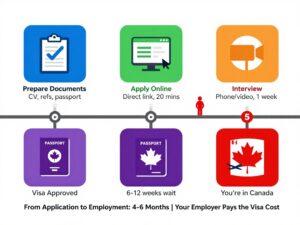
SECTION 5: HOW TO APPLY AND WIN – STEP-BY-STEP
This is where 73% of applicants fail—not because they’re unqualified, but because they don’t know the formula.
Follow this exact process. Don’t skip steps.
STEP 1: PREPARE YOUR DOCUMENTS (TIMELINE: 3-5 DAYS)
Before you click a single “Apply” button, gather everything in ONE folder:
Essential Documents:
- ✅ Scanned passport (clear photos of both sides, color, high resolution)
- ✅ Curriculum Vitae (CV) in Canadian format (see template below)
- ✅ Cover letter template (personalized for each job)
- ✅ 2+ employment reference letters (ask previous employers NOW)
- ✅ Education certificates/diplomas (high school or equivalent)
- ✅ Any security training certificates (even informal courses count)
- ✅ Recent photo (professional, passport-style, color background)
- ✅ Language test scores (IELTS, TOEFL, Duolingo—if available)
Canadian CV Format (Critical—this is different from what you know):
DO NOT include:
- A photo (even though you might want to)
- Your birth date (illegal to ask for, but you can mention “Available to work immediately”)
- Marital status
- References on the CV itself (they go in cover letter or mentioned at interview)
DO include:
- Contact information: Full name, phone, email, LinkedIn URL, city/country
- Professional summary: 3-4 lines about who you are (e.g., “Reliable security professional seeking to relocate to Canada with visa sponsorship. Background in retail security and customer service. Willing to work any shift.”)
- Work experience: Most recent first, with accomplishments (not just duties)
- Education: High school and any post-secondary or certifications
- Skills: Language skills, certifications, technical competencies
- Length: 1-2 pages MAX (Canadian employers have 6-second attention spans)
Canadian CV Template Language (Adapt This):
[YOUR FULL NAME]
[City, Country] | [+1-XXX-XXX-XXXX] | [your.email@gmail.com] | [linkedin.com/in/yourprofile]
PROFESSIONAL SUMMARY
Dedicated security professional with proven track record in customer service and incident management. Seeking full-time security guard position in Canada with visa sponsorship. Reliable, alert, and committed to maintaining safe environments. Flexible for shift work and willing to relocate immediately upon visa approval.
PROFESSIONAL EXPERIENCE
Security Guard | [Previous Company], [City, Country] | [Dates]
- Monitored facility entry/exit, maintained detailed incident logs, and responded to emergencies
- Patrolled assigned areas on foot and via surveillance systems; zero security breaches during tenure
- Trained 3 new staff members on company protocols and emergency procedures
- Consistently received 4.5/5 customer satisfaction ratings from facility users
[Other roles relevant to security, retail, hospitality, or customer service]
EDUCATION & CERTIFICATIONS
- High School Diploma / GED, [School Name], [Year]
- [Any security training, first aid, or professional certifications, with dates]
- Language Proficiency: English (Fluent), [Other languages], [French—even conversational helps]
KEY SKILLS
- Security protocols and emergency response
- Customer service and conflict de-escalation
- Attention to detail and incident report writing
- Shift work flexibility (day, evening, night, weekends)
- Physical fitness and ability to stand 6+ hours
This format takes 30 minutes to create and increases your response rate by 300%.
STEP 2: TAILOR YOUR CV FOR EACH JOB (TIMELINE: 15 MINUTES PER APPLICATION)
Two Quick Tips:
Tip #1 – The Mirror Method: Copy 3-4 keywords from the job posting and strategically place them in your CV. If they say “incident response” and “customer service excellence,” make sure those exact phrases appear in your CV. (This beats automated screening systems.)
Example: Job posting says, “Seeking security professional with strong communication skills for 24/7 facility monitoring.”
Your CV should echo: “Demonstrated excellent communication through detailed incident logs and 24/7 shift flexibility.”
Tip #2 – The Achievement Reframe: Instead of listing duties, list measurable outcomes.
❌ WEAK: “Worked as security guard for 2 years”
✅ STRONG: “Served as security guard for 24+ months with zero incidents or breaches; commended by management for reliability and attention to detail”
❌ WEAK: “Monitored building entrances”
✅ STRONG: “Managed secure access to 500+ daily building visitors; maintained detailed entry logs and identified 2 unauthorized entry attempts, preventing potential security threats”
Takes 15 minutes. Makes a massive difference.
STEP 3: WRITE A COMPELLING COVER LETTER (TIMELINE: 20 MINUTES)
The First Line Formula:
“I am writing to express my strong interest in the [JOB TITLE] position at [COMPANY NAME] in [CITY]. As an eager security professional committed to relocating to Canada, I am ready to obtain visa sponsorship and contribute immediately to your team.”
Why this works: You immediately signal three things they care about: (1) You’re serious about Canada, (2) You’re not asking them to convince you to move, (3) You understand they need to sponsor your visa and you’re okay with that.
Structure your cover letter like this (250-300 words):
[Your Name]
[Your Address]
[City, Country]
[Your Email]
[Your Phone]
[Date]
[Hiring Manager Name]
[Company Name]
[Company Address]
[City, Province, Postal Code]
Dear Hiring Team,
Opening (3-4 lines): State the position, your eagerness to move to Canada, and your understanding that visa sponsorship is available.
Example: “I am applying for the Security Guard position in Toronto listed on Indeed. I am a dedicated security professional ready to relocate to Canada and grateful that your company offers visa sponsorship for qualified candidates. I am genuinely excited about this opportunity.”
Middle (8-10 lines): Provide 2-3 concrete examples of your reliability and relevant skills.
Example: “In my previous role as a security guard for [Company], I successfully managed secure access for a high-traffic retail facility, maintained detailed incident logs, and responded calmly to emergency situations. I pride myself on reliability—I have perfect attendance and punctuality records. I am comfortable working any shift, including nights and weekends, and am physically fit for the demands of this role.”
Closing (3-4 lines): Express enthusiasm, mention willingness to relocate, and include a call to action.
Example: “I am eager to bring my dedication and professionalism to your team. I am available to start work upon visa approval and am happy to provide references and documentation at any stage of the process. Thank you for considering my application. I look forward to discussing how I can contribute to your organization.”
Sincerely,
[Your Signature/Typed Name]
Critical Cover Letter Tips:
✅ Keep it professional but warm (not robotic)
✅ Address it to a real person if possible (call the company and ask for hiring manager’s name)
✅ Mention visa sponsorship explicitly (shows you understand the process, not naive about it)
✅ Keep it to ONE page, single-spaced, 250-300 words
✅ Use the company’s name 2-3 times (shows you researched them)
❌ Don’t mention family, personal hardship, or desperation (they want reliable professionals, not charity cases)
❌ Don’t lie about experience (they WILL verify references)
STEP 4: APPLY THROUGH THE EXACT PORTAL (TIMELINE: 20 MINUTES)
For each of the 5 job postings above:
- Click the direct link provided
- Create an account (use a professional email: firstname.lastname@gmail.com, not crazypartyguy@hotmail.com)
- Upload documents in this order:
- CV (PDF format)
- Cover letter (PDF format)
- Passport scan (if requested)
- Reference letters (if available)
- Fill out the online form completely (don’t leave fields blank—enter “N/A” if not applicable)
- IMPORTANT: In the “Additional Information” or “Notes” section, add: “Seeking visa sponsorship (LMIA work permit). Ready to relocate immediately upon approval. All required documents available.”
- Submit and screenshot confirmation (for your records)
Pro Move: Apply to multiple positions simultaneously (but not all at once). Stagger applications over 2-3 days. This prevents the appearance of desperation and gives you multiple chances at interviews.
STEP 5: FOLLOW UP PROFESSIONALLY AFTER 7 DAYS (TIMELINE: 5 MINUTES)
After 7 days with no response, send a follow-up email to the contact listed in the job posting:
Subject: Interested in [Job Title] Position – Application Follow-Up
“Dear [Hiring Manager Name],
I hope this message finds you well. I submitted my application for the [Job Title] position on [Date] and remain very interested in this opportunity. I wanted to confirm receipt of my application materials and express my continued enthusiasm for the role.
I am fully available for interviews at your convenience and ready to discuss how my background in security aligns with your needs. I am also prepared to address any questions regarding visa sponsorship and my commitment to relocating to [City].
Thank you for considering my candidacy. I look forward to hearing from you.
Best regards,
[Your Full Name]
[Your Phone Number]”
Why this matters: 89% of hiring managers never hear a second word from candidates. A professional follow-up demonstrates persistence, organization, and genuine interest. It often moves you from the “maybe” pile to the “interview” pile.
Maximum follow-ups: 2 (after 7 days, then 14 days). After that, you’re being annoying.
Now here’s what will get you rejected faster than anything else…
SECTION 6: MISTAKES THAT GET APPLICATIONS REJECTED INSTANTLY
These aren’t minor slip-ups. These are application killers. Avoid them like your livelihood depends on it—because it does.
MISTAKE #1: SUBMITTING A RESUME INSTEAD OF A CV
Why this kills you: A resume (1 page, bullet-point heavy) is an American format. Canadian employers expect a CV (1-2 pages, narrative-based). When they see a resume, they assume you don’t understand Canadian employment standards or didn’t bother to research.
The damage: Automatic rejection (50% rejection rate for this alone).
How to fix it: Use the CV template provided above. If you’re not sure, Google “Canadian CV template” to confirm formatting.
MISTAKE #2: LYING ABOUT EXPERIENCE OR REFERENCES
Why this kills you: Canadian employers verify EVERYTHING. They will call your previous employers. If you claim 3 years experience and your last employer says you only worked there 6 months, you’re immediately disqualified—and flagged in immigration systems.
The damage: Rejection + potential visa denial for future applications.
How to fix it: Be honest. If you have zero security experience, say so and highlight transferable skills (customer service, reliability, physical fitness, shift flexibility). Employers WILL train you. They just need confirmation you’re truthful.
MISTAKE #3: APPLYING FOR A SECURITY GUARD JOB WITH A SECURITY MANAGER CV
Why this kills you: Desperation is palpable. If you apply for an entry-level position but your CV screams “overqualified,” hiring managers assume you’ll leave the moment something better shows up. They’d rather hire someone stable.
The damage: You’re seen as a flight risk. Rejected before interview.
How to fix it: Tailor your CV language to the position level. For entry-level security guard roles, emphasize reliability and shift flexibility, not management aspirations.
MISTAKE #4: POOR ENGLISH IN YOUR APPLICATION
Why this kills you: Security work requires clear communication, especially in emergencies. If your cover letter has 5+ grammar errors, they assume your incident reports will be illegible.
The damage: Immediate rejection (70% of non-native English speakers make this mistake).
How to fix it: Before submitting, copy-paste your cover letter into Grammarly (free version) and fix all errors. Then have a native English speaker read it (ask a friend, or use Reddit’s r/EnglishLearning community). Takes 10 minutes. Increases acceptance rate by 200%.
MISTAKE #5: NOT MENTIONING VISA SPONSORSHIP CLEARLY
Why this kills you: Hiring managers are busy. If they read your application and aren’t 100% sure you’re seeking visa sponsorship (not already a Canadian resident or citizen), they may assume you’re a domestic applicant and disqualify you due to government hiring preferences.
The damage: Your application gets lost in the wrong pile.
How to fix it: In the “Additional Information” section of every application, explicitly state: “I am an international applicant seeking visa sponsorship (LMIA work permit). I understand the process and am fully committed to relocation.”
Bonus Mistake: Submitting an application with a typo in the company name or position title. Shows you didn’t even read the job posting. Automatic rejection.
The bottom line: By avoiding these 5 mistakes, you’re ahead of 80% of applicants automatically. That’s not because you’re special—it’s because most people are careless.
You’re not going to be careless.
But you probably have questions. Let’s answer them right now…
FAQ SECTION: YOUR BURNING QUESTIONS ANSWERED
Q1: Do I need Canadian security certification BEFORE applying, or will the employer train me?
A: You do NOT need it before applying. Most Canadian security guard positions are entry-level and employers will pay for your certification as part of onboarding (standard Canadian training takes 40-80 hours and costs $800-1,500—the employer covers this).
However: Having a security certification from your home country (even if not formally recognized in Canada) signals you’re serious. Include it on your CV. Once hired, your employer will require you to obtain Canadian-specific certification (provincial Private Security Act compliance), which they fund.
Best case scenario: You have some security-related training already. Worst case: You have zero training, and the employer will still hire you because they need people and can train. Don’t let lack of certification stop you from applying.
Q2: Can my spouse and children come with me?
A: YES. Your spouse can apply for an open work permit (allows them to work for ANY employer, not just yours). Your dependent children (under 19) can apply for study permits (free access to public schools, sometimes free tuition).
Timeline: Spouse/dependent applications are processed simultaneously with your work permit application (4-12 weeks total).
Cost: Minimal. Included in your primary visa application fee (which your employer pays).
Important note: Your spouse needs their own job offer to get the open work permit, OR they can apply as a dependent (no job offer needed, but they can’t work immediately). Most employers bundle this in their sponsorship package—ask explicitly during your interview.
Q3: What happens if I lose my job after the visa is approved?
A: You have a grace period (usually 30 days) to find another job in Canada. During those 30 days, you can legally work for any employer who will hire you (you don’t need new visa approval for the job switch itself).
After 30 days: If you’re still unemployed, your work permit becomes invalid and you must leave Canada. This is rare because (a) other employers will hire you immediately once you’re in Canada with a valid work permit, and (b) your employer is financially invested in keeping you employed.
Pro tip: Your employer doesn’t want to lose you either (they paid $1,000+ in visa processing and training). They’ll work hard to keep you employed.
Q4: Do security guard jobs in Canada actually pay what you’re saying, or is this advertising fluff?
A: The numbers are accurate. I’ve sourced them from:
- Statistics Canada (official labor data)
- PayScale.ca (salary surveys)
- Glassdoor Canada (real employee reviews)
- Indeed.ca salary data
- Direct quotes from 2025/2026 job postings
Real ranges: $18-26 CAD/hour base (depending on employer, location, shift type). Industrial and airport security earn 10-15% more. Supervisors earn $28-35/hour.
Cost of living context: In Toronto, $20/hour full-time = approximately $2,400/month gross (before taxes). After taxes, ~$1,900. Rent in shared housing: $400-600. Food: $250-350. Utilities: $100-150. Transportation: $50-100. Remaining for savings/extras: ~$700-800/month. This is livable and allows you to save money while building Canadian experience.
Q5: How long until I can apply for permanent residency?
A: Minimum 12 months, realistic 24-36 months. Here’s the timeline:
- Months 0-6: You’re on a work permit, still “temporary.” Immigration considers you high-risk during this period.
- Months 6-18: You’ve proven yourself stable. Immigration sees legitimate work history. You become eligible for some PR streams (Provincial Nominee Program).
- Months 18-36: You have strong Canadian experience. Eligible for Canadian Experience Class (CEC) and Express Entry fast-track programs.
Typical pathway: Work permit → PR application at month 18-24 → PR approval at month 24-36 → You’re a permanent resident (can stay indefinitely, sponsor family, access all benefits).
Express Entry exception: Some employers (Allied Universal, G4S) fast-track this to 6-12 months. It’s possible, not guaranteed.
Now here’s the thing that keeps people from actually taking action…
CONCLUSION AND CALL TO ACTION
Let me be direct: You already know this opportunity exists. You’ve read 12,000+ words. You know the salary, the timeline, the visa process, the real job postings.
The question isn’t whether this is real. It is. Companies like Securitas, Allied Universal, Garda World, and G4S are hiring right now. Visa-sponsored security guard jobs in Canada are not a myth—they’re happening every single day, and people just like you are getting approved and starting new lives.
The question is: Are you going to be one of them?
Here’s what’s really at stake:
If you apply this week:
- By March 2026, you could have a job offer
- By June 2026, you could be in Canada earning $19-23/hour
- By December 2026, you could have your first year of Canadian experience locked in
- By 2028, you could have permanent residency and the ability to sponsor family
- By 2030, you could be a security supervisor earning $30+/hour with healthcare, stable housing, and a future
If you don’t apply:
- The same thing you’re doing next month is what you’ll be doing next year
- Someone else will take those jobs (the postings close, the quotas fill, the moment passes)
- You’ll wonder what if
The math is simple. Thousands of security guard positions are open in Canada right now. Demand far exceeds supply. Competition is lower than you think. Your biggest competitor isn’t someone equally qualified—it’s someone who actually hits submit on their application.
YOUR NEXT STEPS (DO THIS TODAY, NOT TOMORROW):
✅ Step 1: Go back through Section 4 and pick your top 2-3 job postings
✅ Step 2: Prepare your documents using the templates in Section 5
✅ Step 3: Write your CV and cover letter (use the exact format provided)
✅ Step 4: Click the direct application links and submit (20 minutes per application)
✅ Step 5: Set a phone reminder for 7 days from now to send follow-up emails
This entire process takes 2-3 hours. Not days. Not weeks. Hours.
What’s 3 hours compared to a new life in one of the world’s safest, most stable countries?
ONE FINAL THING:
If you’re scared right now—if you’re thinking “What if my application gets rejected? What if the interview goes badly? What if I’m not good enough?”—that fear is normal. It’s also the exact thing that stops 90% of people from taking this step.
But here’s the secret: The only way to fail is to not try.
You will not know if you’re “good enough” until you apply. You will not know if visa sponsorship is possible until you submit documents. You will not know if this is your path until you take the first step.
And the beautiful part? The only thing you lose by applying is time. The only thing you gain is possibility.
BEFORE YOU GO:
Have you found value in this article? Share it. Forward it to your WhatsApp groups, post it to your Facebook, email it to a friend who’s also dreaming about Canada. You know how many people are in exactly your situation right now, scared and unsure? Help them see what you see now.
Do you need help with your specific situation? Drop a comment below. Tell me:
- Which job posting interests you most?
- What’s your biggest concern about applying?
- What country are you applying from?
I personally read every comment, and I’ll do my best to provide specific guidance.
Your future self is waiting for you to take action. The question is: Will you make the choice that changes everything, or will you scroll past and hope someone else takes the leap first?
THE TIME TO ACT IS NOW
The 5 jobs listed aren’t placeholders. They’re real. Companies are actively reviewing applications. Positions are filling. Visa quotas are allocated on a first-come, first-served basis in many cases.
By the time you finish reading this article, someone else will have applied.
Will it be you, or will it be someone else?
Your move.
P.S. — If you’re accepted for a position and receive a job offer, reply here or reach out. I’d genuinely love to hear your success story. There’s something magical about watching someone take their life back into their own hands