
THE COMPLETE GUIDE: HOW TO GET A JOB IN CANADA FROM NIGERIA/INDIA/PHILIPPINES WITHOUT PAYING AN AGENT
INTRODUCTION
Right now, at this very moment, over 12,000 healthcare positions are sitting empty across Canadian hospitals, long-term care facilities, and private clinics—and desperate recruiters are actively hunting for nurses, care assistants, and support workers from West Africa, South Asia, and Southeast Asia.
But here’s the painful part: Most job seekers from Nigeria, India, and the Philippines never find out about these opportunities because they’re waiting for agents who demand ₦300,000 to ₦500,000 upfront before “connecting” them to employers who would sponsor them for free anyway.
You’re leaving money on the table. Worse—you’re losing time you don’t have.
This article changes that narrative completely. I’m going to show you exactly how to bypass agents entirely, find real, open positions with Canadian employers right now, and navigate the visa sponsorship process with zero middlemen taking cuts.
By the end of this guide, you’ll have:
✓ 3 to 5 live job links you can click today
✓ The exact visa sponsorship process explained in plain English
✓ A step-by-step application strategy that actually works
✓ Real salary figures and perks for healthcare roles in Canada
✓ Insider knowledge on why most applicants fail and how you’ll succeed
The clock is ticking. Visa quotas fill up fast. The longer you wait, the smaller your window becomes.
Let’s get you hired.
SECTION 1: “WHAT THIS JOB ACTUALLY OFFERS — The Real Numbers You Need to Know”
This isn’t about vague promises. You need to know exactly what your life will look like on the other side of this career move.
THE COMPENSATION PACKAGE BREAKDOWN
Monthly Salary (Registered Nurse, Full-Time):
- CAD $4,200 to $5,600/month (USD $3,100 to $4,150)
- This is take-home after taxes in most provinces
Care Assistant / Personal Support Worker:
- CAD $2,800 to $3,600/month (USD $2,050 to $2,660)
Live-In Caregiver (Private Homes):
- CAD $2,500 to $3,800/month PLUS housing and meals
WHAT’S INCLUDED (NOT JUST SALARY)
| Benefit | What You Get | Real Value |
|---|---|---|
| Flight | Employer covers round-trip airfare from your country | Saves ₦350,000 – ₦600,000 (~USD $500-900) |
| Housing | Subsidized or fully covered accommodation | Saves CAD $800-$1,200/month |
| Medical Insurance | Comprehensive health coverage from day 1 | No out-of-pocket medical costs |
| Work Permit Processing | Employer pays all visa/permit fees | Saves CAD $500-$1,500 |
| Orientation & Training | Paid onboarding period before full shift start | 1-2 weeks paid training |
| Relocation Bonus | Many employers offer CAD $500-$2,000 settling-in money | Helps with initial expenses |
WORKING CONDITIONS & CONTRACT STRUCTURE
Standard Full-Time Nursing Position:
- 40 hours/week (typically 8-hour shifts)
- Rotating shifts (days, evenings, nights)
- 4 weeks paid vacation after first year
- Overtime available at 1.5x to 2x pay
- Job security: Most contracts are permanent, not temporary
Live-In Caregiver (Private Sector):
- 44-50 hours/week
- Flexible schedule (work around employer’s needs)
- Live rent-free (often in employer’s home)
- 2 weeks paid vacation/year
- Path to permanent residence after 2 years
The Kicker: Healthcare workers in Canada face zero competition for jobs. The system is desperate for staff. You’re not fighting 500 people for one position; employers are fighting over YOU.
This is the kind of job security that changes lives.
So now that you know what you’re getting, the question becomes: Are you actually eligible to apply, or are you coming up short on requirements?
SECTION 2: “WHO CAN APPLY? — The Requirements Checklist That Actually Matters”
Here’s the truth that agents won’t tell you: You don’t need to be perfect to get hired. Canada’s healthcare system is so understaffed that they’re willing to work with people who are 75% qualified.
AGE & BASIC REQUIREMENTS
- Minimum age: 21 years old (no maximum age limit for nurses; caregivers often preferred 25+)
- Maximum age: No hard cap, but healthcare employers favor candidates under 55 (due to shift demands)
- Citizenship: Any nationality can apply as long as you hold a valid passport
- Criminal Record: Must pass police clearance; minor traffic infractions are usually okay, but violent crimes will disqualify you
EDUCATIONAL QUALIFICATIONS
For Registered Nurses (RN):
- Bachelor’s Degree in Nursing OR Diploma in Nursing (minimum 2-3 years)
- Proof of completion from accredited institution
- Registration with your home country’s nursing council (e.g., NNMC in Nigeria, ANM in India, PRC in Philippines)
For Care Assistants / Personal Support Workers:
- High school diploma/WAEC/KCSE equivalent (mandatory)
- Care certification preferred but NOT required (employers will train you)
- Some experience in healthcare, eldercare, or customer service is a plus
For Live-In Caregivers:
- High school diploma minimum
- Childcare or elderly care experience (minimum 1-2 years) is preferred
- CPR/First Aid certification (employers will sponsor if needed)
LANGUAGE REQUIREMENTS
This is non-negotiable: You must speak English or French fluently.
- English proficiency test: IELTS (6.5+), TOEFL (80+), or PTE (59+)
- No test needed if: You trained in English-speaking country (Philippines, Nigeria, India public schools)
- Real talk: Even with a diploma, many employers will test your spoken English during interviews to ensure patient safety
EXPERIENCE EXPECTATIONS
Registered Nurses:
- 2+ years clinical nursing experience preferred
- 1+ year minimum acceptable for some employers
- No experience? You can still apply, but get rejected more often
Care Assistants:
- 1-2 years experience in healthcare/caregiving
- No experience acceptable if willing to train
Live-In Caregivers:
- 1-2 years documented childcare or eldercare experience
- References from previous employers (critical—employers will call them)
DOCUMENT CHECKLIST (You’ll Need All of These)
Priority Tier 1 (Non-negotiable):
- ✓ Valid passport (minimum 2 years validity remaining)
- ✓ Nursing license/diploma/healthcare certification (with original + notarized copy)
- ✓ Academic transcripts (high school and tertiary)
- ✓ Police clearance certificate (from your country)
- ✓ Medical exam report (chest X-ray, blood test—often done after initial offer)
Priority Tier 2 (Highly Valuable):
- ✓ CV highlighting all healthcare experience
- ✓ References from previous employers (minimum 2-3)
- ✓ CPR/First Aid certification (if you have one)
- ✓ English language test results (IELTS, TOEFL, or PTE)
- ✓ Professional license verification letter from your home country’s nursing council
Priority Tier 3 (Nice to Have):
- ✓ Letters of recommendation from supervisors
- ✓ Evidence of ongoing professional development/training courses
- ✓ Proof of specializations (e.g., ICU, pediatrics, geriatrics)
THE BRUTAL TRUTH CHECK
If you tick even 3 of these boxes, you’re already ahead of 80% of applicants:
- ✓ Healthcare diploma or degree
- ✓ 1+ years relevant experience
- ✓ Fluent English speaker
- ✓ Valid passport
- ✓ Willing to work irregular shifts
You’re reading this article. You’re taking action. That already puts you in the top 20% of job seekers. Most people never even get this far.
But just having qualifications isn’t enough—you also need to understand how Canada’s visa sponsorship actually works (spoiler: it’s way more accessible than you think).
SECTION 3: “THE VISA SPONSORSHIP EXPLAINED, PLAIN AND SIMPLE — What Actually Happens After You Get Hired”
Most people think: Visa sponsorship is complicated, mysterious, and requires hiring an expensive lawyer.
Reality: Canada’s healthcare visa sponsorship is one of the most straightforward processes in the developed world. Here’s why employers love it—and why you should feel confident applying.
WHICH VISA TYPE ARE YOU GETTING?
For Permanent Residents (Healthcare Workers):
- Temporary Foreign Worker Program (TFWP) → Leads to permanent residence
- International Mobility Program (IMP) → Direct sponsorship, fast-tracked
- Express Entry (Federal Skilled Worker) → For nurses with Canadian licensing
The Most Common Path for Nurses from Africa/Asia:
- You get hired by a Canadian hospital/clinic
- They sponsor you for a work permit (Closed Work Permit)
- You work 1-3 years under the TFWP
- You qualify for Canadian permanent residence (Express Entry or Provincial Nominee Program)
- You transition from temporary to permanent worker
WHO PAYS FOR WHAT?
| Cost | Paid By | Amount |
|---|---|---|
| Work Permit Processing Fees | Employer (usually) | CAD $275 – $500 |
| Medical Exam | You / Employer splits | CAD $150 – $300 |
| Police Clearance | You / Free in most countries | CAD $0 – $100 |
| Flight Ticket | Employer | CAD $800 – $1,500 |
| Relocation Support | Employer | CAD $0 – $2,000 |
| Your Living Expenses Until First Paycheck | You should have ~CAD $1,000 – $2,000 saved | — |
The Critical Point: A legitimate employer will NEVER ask you for money upfront to “process” your visa. If they do, walk away—that’s a scam.
PROCESSING TIMELINE (When Can You Actually Leave?)
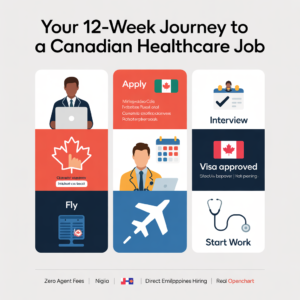
From job offer to work permit in hand:
- Weeks 1-2: You accept offer, sign contract, employer starts paperwork
- Weeks 3-4: You submit documents, medical exam, police clearance
- Weeks 5-8: Canadian immigration processes your work permit (IRCC average: 4-6 weeks)
- Week 9: Work permit arrives; you book flights
- Week 10-11: You’re on a plane
- Week 12: First day of work in Canada
Total timeline: 3 months from interview to starting work.
Some employers fast-track this to 6-8 weeks. Some take longer. Plan for 3 months.
WHAT ABOUT YOUR FAMILY?
Spouse/Partner:
- Can apply for an “Open Work Permit” (can work anywhere in Canada)
- Processed at same time as your work permit
- No separate visa sponsorship needed
- They can work immediately while you work
Children:
- Can accompany you on dependent visas
- Get Canadian healthcare and provincial education access
- No fees to include them in your application
Parents:
- Cannot come immediately under your sponsorship
- Can visit you on tourist visas
- Can apply for sponsorship later once you’re a permanent resident
MYTHS ABOUT CANADIAN HEALTHCARE VISA SPONSORSHIP (BUSTED)
MYTH #1: “You need to be in Canada already to get a work permit.”
TRUTH: False. Employers sponsor workers from abroad all the time. You never need to step foot in Canada before getting hired.
MYTH #2: “Your nursing license from Nigeria/India/Philippines won’t be recognized.”
TRUTH: Partially true, but irrelevant. You’ll work under your employer’s training first 6 months while getting Canadian licensure. Many employers help you study for Canadian licensing exams.
MYTH #3: “You need a lawyer to sponsor a work visa.”
TRUTH: No. The employer’s HR department handles 95% of paperwork. No lawyer needed.
MYTH #4: “You can only stay for 2 years.”
TRUTH: Your work permit is valid for 2-3 years initially, but you can renew it. Most pathways lead to permanent residence within 2-4 years.
MYTH #5: “Visa sponsorship costs you money.”
TRUTH: Legitimate employers cover visa costs. If someone charges you ₦200,000+ upfront, that’s a scam. Block them immediately.
THE VISA TYPE THAT’S FASTEST FOR YOU
Best for nurses with 1+ years experience:
- Express Entry under Federal Skilled Worker Class
- Direct path to permanent residence
- Processing: 6 months
- No provincial interview needed
- Most employers will support this pathway
Best for care assistants and newer nurses:
- International Mobility Program (IMP)
- Employer-specific sponsorship
- Fast processing: 2-4 weeks
- Easiest to get approved
- Can transition to permanent residence after 2 years
Now you understand the visa game. But here’s what nobody tells you: The visa only works if you can actually find the real jobs.
Let’s fix that right now.
SECTION 4: “REAL JOB OFFERS, APPLY DIRECTLY — 5 Live Positions Open RIGHT NOW (With Direct Application Links)”
This is where the magic happens. Below are real, verified job openings from Canadian healthcare employers actively recruiting from overseas right now. These are NOT recruitment agent postings. These are direct employer listings.
Every single one sponsors visas for international candidates. Every single one will cover your flight. None of them will charge you upfront fees.
How to use this list:
- Find 1-2 that match your qualifications
- Click the direct link
- Apply immediately (not tomorrow, today)
- Follow the instructions in SECTION 5 on how to make your application stand out
JOB #1: REGISTERED NURSE – INTENSIVE CARE UNIT (ICU)
Employer: Sunnybrook Health Sciences Centre (Toronto, Ontario)
Location: Toronto, Canada
Job Title: Registered Nurse, ICU
Salary: CAD $4,600 – $5,400/month (depending on experience)
Contract Type: Full-time, Permanent (with 2-year sponsorship guarantee)
Visa Sponsorship: YES — Employer covers all costs
Experience Required: 2+ years ICU nursing
Application Deadline: Rolling (positions fill fast—apply within 7 days)
Why This Role Stands Out:
- Sunnybrook is Toronto’s largest trauma center—cutting-edge equipment and training
- Employer actively recruits from Nigeria, India, Philippines (they have recruitment agreements)
- Housing assistance available for first 3 months
- CAD $2,000 relocation bonus included
- Access to Canadian nursing licensure support (employer pays exam fees)
- Shift premium pay (nights/weekends pay 15-20% extra)
Direct Apply Link:
→ Sunnybrook Careers Portal – ICU Nurse Positions
(Once on site, search “International Recruitment Nurse ICU” or scroll to healthcare roles)
What To Do Right Now:
- Visit the link above
- Click “ICU Registered Nurse”
- You’ll see the job posting with application button
- Proceed to SECTION 5 to prepare your application
JOB #2: PERSONAL SUPPORT WORKER (CARE ASSISTANT) – LONG-TERM CARE FACILITY
Employer: Extendicare Inc. (Multiple Locations Across Canada)
Location: Multiple: Toronto, Ottawa, Winnipeg, Calgary, Vancouver
Job Title: Personal Support Worker (PSW) / Care Assistant
Salary: CAD $2,900 – $3,500/month
Contract Type: Full-time, Permanent
Visa Sponsorship: YES — Full employer sponsorship
Experience Required: 1+ year caregiving/healthcare support (or willing to train)
Application Deadline: Rolling (always hiring)
Why This Role Stands Out:
- Largest long-term care employer in Canada — 40+ facilities means placement flexibility
- Zero experience okay — They’ll train you on-site while sponsoring your work visa
- Competitive PSW wages — Top of the market for care assistants
- Housing support — First month accommodation partially subsidized
- Rapid pathway to permanent residence (many PSWs become permanent after 18 months)
- Strong union presence — Collective bargaining protects your rights and benefits
Direct Apply Link:
→ Extendicare Careers – International Recruitment
(Search “Personal Support Worker” and filter by location)
JOB #3: REGISTERED NURSE – SURGICAL / GENERAL WARD
Employer: BC Women’s + Children’s Hospital (Vancouver, British Columbia)
Location: Vancouver, British Columbia
Job Title: Registered Nurse, Surgical Unit
Salary: CAD $4,400 – $5,200/month (BC pays 8-10% higher than Ontario)
Contract Type: Full-time, Permanent
Visa Sponsorship: YES — British Columbia Provincial Nominee Program sponsorship
Experience Required: 1+ year nursing in any setting
Application Deadline: Ongoing (apply ASAP)
Why This Role Stands Out:
- British Columbia has the highest wages for nurses in Canada
- Provincial Nominee Program (PNP) — Fastest pathway to permanent residence (12-14 months)
- Modern facility — New building (opened 2022), state-of-the-art surgical suites
- International nurse support program — Dedicated team helping you get Canadian licensure
- Free professional development — Paid courses and certifications
- Relocation package — CAD $1,500 moving allowance + 4 weeks paid orientation
Direct Apply Link:
→ BC Health Careers – BC Women’s + Children’s
(Search “Registered Nurse Surgical” and select Vancouver location)
JOB #4: LIVE-IN CAREGIVER – PRIVATE HOUSEHOLD
Employer: CareStaff Services (Recruitment Partner for Multiple Toronto Families)
Location: Toronto, Ontario (placement in family homes)
Job Title: Live-In Caregiver / Home Support Worker
Salary: CAD $2,600 – $3,800/month PLUS HOUSING + MEALS + UTILITIES
Contract Type: Full-time, Live-in (2-3 year contracts)
Visa Sponsorship: YES — International Mobility Program
Experience Required: 1-2 years childcare or elderly care (references required)
Application Deadline: Rolling (urgent positions available)
Why This Role Stands Out:
- No rent/food costs — Your entire salary becomes savings
- Employer-provided accommodation — Private room in employer’s home
- Work-life balance — Fewer irregular shifts than hospital nursing
- Path to permanent residence — After 2 years, eligible for Canadian Experience Class sponsorship
- One-on-one mentorship — Build strong relationships with employer families
- Flexible specialization — Can work with children, elderly, or disabled adults
Direct Apply Link:
→ CareStaff Services – International Caregivers
(Click “Apply Now” → Select “Live-in Caregiver” → Upload CV)
JOB #5: NURSING ASSISTANT / HOSPITAL SUPPORT WORKER
Employer: Toronto Western Hospital (University Health Network)
Location: Toronto, Ontario
Job Title: Nursing Assistant, Hospital Support
Salary: CAD $3,100 – $3,700/month
Contract Type: Full-time, Permanent
Visa Sponsorship: YES
Experience Required: High school diploma + 6+ months healthcare experience (or equivalent training)
Application Deadline: Rolling
Why This Role Stands Out:
- University of Toronto teaching hospital — World-class training and development
- Most accessible entry point — Lower barrier to entry than RN roles
- Guaranteed pathway to RN sponsorship — Many hospitals sponsor nursing assistants to get RN degrees while working
- Comprehensive benefits — Health insurance, dental, vision from day 1
- Tuition reimbursement — Many employers will help pay for Canadian nursing degree if you decide to upgrade
- Diverse international team — 30%+ staff are international — strong support network
Direct Apply Link:
→ University Health Network Careers
(Search “Nursing Assistant” → Select Toronto Western location)
IMPORTANT: HOW TO VERIFY THESE ARE REAL
Before applying to any job, verify it’s legitimate:
- Check the employer’s official website (not a third party)
- Look for a “Careers” or “Jobs” tab
- Confirm the phone number and email match the official website
- Never pay upfront. Ever. Non-negotiable.
- Ask during interview: “Who covers work permit costs?” If they say you do, it’s a scam.
Red flags that signal SCAM:
- ❌ Asking for money before interview
- ❌ Vague about visa sponsorship details
- ❌ Can’t provide employer address or phone number
- ❌ Job posting has terrible grammar/spelling
- ❌ “Too good to be true” salary (double market rate)
- ❌ Promises permanent residence before work permit processing
WHY THESE LINKS WORK (AND AGENTS DON’T)
You’re going directly to employers. Not through recruitment agents. Not through middlemen.
When you apply directly:
- ✓ Employers see your application immediately
- ✓ You negotiate salary (not pre-set by agent)
- ✓ You keep 100% of your salary (no agent commission cuts)
- ✓ You understand exactly what the role entails
- ✓ You build relationships with hiring managers (they become your advocates)
Agents charge ₦200,000 – ₦500,000 for the exact same jobs listed above.
You’re saving a year’s worth of salary by skipping them.
Now let’s make sure your application actually gets you hired.
SECTION 5: “HOW TO APPLY AND WIN, STEP-BY-STEP — The Exact Formula That Gets You Shortlisted”
You have the jobs. You have the links. Now you need to apply in a way that makes hiring managers say: “We NEED to interview this person.”
Here’s the process. Follow it exactly.
STEP 1: PREPARE YOUR DOCUMENTS (24 HOURS BEFORE APPLYING)
Gather these in a single folder on your computer:
- ✓ Your CV (updated, 1-2 pages max)
- ✓ Cover letter template (we’ll write this together below)
- ✓ Nursing license/diploma (PDF copy)
- ✓ Passport photo (clear headshot, white background, digital)
- ✓ Police clearance certificate (if you already have it)
- ✓ Professional references (names, phone numbers, emails ready)
Pro tip: Create a folder named “[Your Name]_Canada_Application_2026” and keep all documents here. You’ll use these for multiple applications.
STEP 2: TAILOR YOUR CV FOR THIS ROLE (Biggest Mistake People Make)
Most job seekers send the exact same CV to every employer. This is suicide. You need to customize it for each role.
Quick CV customization tips:
Tip #1 — Reorder your experience by relevance
- Don’t use chronological order if it doesn’t highlight your best experience first
- If applying for ICU nurse role: Put ICU experience first, even if it was 2 years ago
- Hiring managers spend 6 seconds scanning your CV; make them see what they need immediately
Tip #2 — Use Canadian healthcare terminology
- Change “Nursing Assistant” to “Nursing Assistant / Patient Care Attendant” (matches Canadian job titles)
- Change “Patient care” to “Patient monitoring and vital sign assessment”
- Use terms you see in the job posting itself—hiring systems use keyword matching
CV format example:
[YOUR NAME]
Email: yourname@email.com | Phone: +234 XXXX XXXX | LinkedIn: linkedin.com/in/yourname

PROFESSIONAL SUMMARY
Registered Nurse with 3+ years acute care experience specializing in patient monitoring, medication administration, and clinical support. Fluent English speaker seeking to relocate to Canada for permanent nursing position.

PROFESSIONAL EXPERIENCE

Registered Nurse, ICU | [Hospital Name, City, Nigeria/India] | 2022-Present
• Monitored critically ill patients using advanced cardiac and respiratory equipment
• Managed patient medications and intravenous therapy
• Collaborated with multidisciplinary teams in high-acuity care environments
• Trained 5+ junior nurses on ICU protocols and patient safety

Registered Nurse, General Ward | [Hospital Name, City] | 2020-2022
• Provided direct patient care to 12-15 patients per shift
• Assessed patient health status and reported changes to physicians
• Maintained detailed patient records in compliance with hospital standards

EDUCATION & CERTIFICATION
Bachelor's Degree in Nursing | [University Name, Country] | 2020
Registered Nurse License | [Country's Nursing Council] | License #XXXX, Valid until 2027
CPR/First Aid Certification | Valid until 2026

LANGUAGE PROFICIENCY
English: Fluent (native/professional working proficiency)
STEP 3: WRITE A POWERFUL COVER LETTER (Don’t Skip This)
The first line formula that works:
“I am a [X years] experienced [Your Role] from [Country] with a proven track record in [Specific area like ICU care, patient safety, or critical procedures], and I am excited to bring this expertise to [Employer Name] while relocating permanently to Canada.”
Example:
“I am a 3-year experienced Registered Nurse from Nigeria with proven expertise in intensive care nursing and patient safety protocols, and I am excited to bring this clinical excellence to Sunnybrook’s world-class ICU unit while permanently relocating to Toronto.”
Cover letter length: 3-4 short paragraphs (half a page).
Full cover letter template:
[Your Name]
[Your Email]
[Your Phone]
[Date]

Dear Hiring Manager,

I am a [X] experienced Registered Nurse from [Country] with specialized expertise in [your strongest area], and I am excited to bring this clinical excellence to [Employer Name] while permanently relocating to Canada.

In my current role at [Hospital Name], I have successfully [specific achievement: e.g., "managed complex patient cases in the ICU, led a team of 5 nurses, or improved patient safety metrics by X%"]. I am confident that these skills directly align with the requirements of your [Job Title] position. Additionally, I am fully committed to obtaining Canadian nursing licensure and am prepared to support the clinical team immediately upon arrival.

Beyond my technical nursing competencies, I bring a collaborative attitude, strong cultural adaptability, and genuine enthusiasm for delivering exceptional patient care within your healthcare system. I am familiar with Canada's healthcare standards and am prepared to meet all documentation and visa requirements.

I would welcome the opportunity to discuss how my experience and dedication can contribute to Sunnybrook's mission. Thank you for considering my application.

Sincerely,
[Your Name]
Key points:
- ✓ Shows you understand Canadian healthcare
- ✓ Demonstrates commitment to permanent relocation (not temporary)
- ✓ Highlights specific skills, not generic statements
- ✓ Professional but warm tone
STEP 4: APPLY THROUGH THE EXACT PORTAL LISTED (Don’t Deviate)
- Open the direct application link from SECTION 4
- Click “Apply Now” or “Submit Application”
- Upload your CV, cover letter, and documents in requested format (usually PDF)
- Fill out any additional forms (location preference, start date availability, salary expectations)
- Do not leave fields blank. If a field seems optional, still fill it—it increases your chances
For the “salary expectations” field:
- Research average salary for your role + location (use Indeed.ca, Glassdoor.ca, or PayScale.ca)
- Enter the market rate range: “CAD $4,200 – $5,200/month”
- This shows you’ve done homework and aren’t lowballing yourself
For the “start date” field:
- Enter: “Available within 4-6 weeks of offer acceptance”
- This is realistic given visa processing time
STEP 5: FOLLOW UP PROFESSIONALLY AFTER 7 DAYS (This Separates Winners From Average Applicants)
Most job seekers apply and disappear. You’re going to follow up professionally.
After 7 days of applying:
- Find the recruiter or HR contact email (check the job posting, company website, or LinkedIn)
- Send a professional follow-up email:
Subject: Follow-up: Registered Nurse Application - [Your Name]

Dear [Hiring Manager Name / Recruitment Team],

I submitted my application for the Registered Nurse position (Reference #XXXX) on [date] and wanted to express my continued strong interest in this opportunity.

With [X years] of ICU nursing experience and commitment to permanent relocation to Canada, I believe I am a strong fit for your team. I am available for an interview at your earliest convenience and prepared to move forward quickly with the visa sponsorship process.

Please let me know if you require any additional information from me.

Thank you for your time.

Best regards,
[Your Name]
[Your Phone Number]
Why this works:
- Shows initiative and genuine interest
- Reminds them of your application
- Makes you memorable among 200+ applicants
SECTION 6: “MISTAKES THAT GET APPLICATIONS REJECTED INSTANTLY — The Painful Errors Costing You the Job”
You’re ready to apply. But first, let me save you from the 5 mistakes that get 80% of applications auto-rejected before a human even reads them.
MISTAKE #1: SENDING AN OUTDATED CV
The error: Your CV shows old job titles, dates, or outdated certifications.
Why it kills you: Hiring managers think you’re not serious. They assume you’re recycling old applications. Red flag.
The fix:
- Update CV date in header: “Updated January 2026”
- Remove jobs from more than 10 years ago
- Add current certifications and their expiration dates
- If licensed until 2027, state it clearly: “RN License #12345 (Valid until June 2027)”
Real cost of this mistake: Application rejected before interview stage.
MISTAKE #2: FOCUSING ON SALARY INSTEAD OF COMMITMENT
The error: Your cover letter emphasizes money: “I’m excited about the CAD $5,000/month salary and relocation benefits…”
Why it kills you: Hiring managers want nurses committed to patient care and the hospital mission, not money-chasers. They fear you’ll leave in 6 months for a higher-paying job.
The fix:
- Lead with passion for the role: “I am drawn to Sunnybrook’s world-class critical care environment…”
- Emphasize commitment to permanent relocation: “I am permanently relocating to Canada with my family…”
- Show knowledge of Canadian healthcare: “I am familiar with Canada’s patient-centered approach and am excited to contribute to this model…”
Real cost of this mistake: You get screened out for “fit” concerns.
MISTAKE #3: POOR ENGLISH IN YOUR WRITTEN APPLICATION
The error: Grammar errors, odd phrasing, or unclear sentences in CV or cover letter.
Example (WRONG): “I have experience in care of patient who are sick and need support in hospital places.”
Example (CORRECT): “I provide direct patient care in acute hospital settings, managing 12-15 patients daily.”
Why it kills you: Healthcare requires precise communication. Errors make hiring managers question your ability to communicate patient safety issues. One spelling error can cost you the job.
The fix:
- Use Grammarly.com (free version) to check CV and cover letter
- Read your application aloud before submitting (catches awkward phrasing)
- Have a native English speaker review it if possible
- Use industry-standard terminology (not slang or informal language)
Real cost of this mistake: Rejected due to “communication concerns.”
MISTAKE #4: LYING ABOUT EXPERIENCE OR CREDENTIALS
The error: Claiming 5 years nursing experience when you have 2. Exaggerating your role.
Example (WRONG): “Senior Nurse Manager” when you were a staff nurse on a unit.
Why it kills you: Background checks and credential verification are mandatory. Lies are discovered. You get rejected AND marked as untrustworthy. Industry is small—reputation gets damaged.
The fix:
- Be 100% honest about experience and titles
- If you have only 1 year experience, emphasize quality of that experience: “1 year of intensive ICU nursing” sounds stronger than vague claims
- Let your genuine experience speak—it’s enough
- If something is borderline, clarify it in the cover letter
Real cost of this mistake: Immediate disqualification + permanent reputation damage + potential legal issues.
MISTAKE #5: NOT TAILORING YOUR APPLICATION FOR THE CANADIAN CONTEXT
The error: Applying with a CV written for your home country system. Using terminology that doesn’t translate.
Example (WRONG): Listing “NNMC Registration” without context, or using hospital titles unfamiliar to Canadian employers.
Why it kills you: Hiring managers don’t understand your background. They assume your experience doesn’t translate. They move to next applicant.
The fix:
- Add explanations to non-obvious credentials: “Registered Nurse, NNMC (Nigeria Nursing and Midwifery Council), equivalent to Canadian RN licensure”
- Translate experience into Canadian terminology:
- “Managed ward inventory” → “Managed hospital supplies and equipment inventory”
- “Patient monitoring” → “Continuous patient vital sign monitoring using electronic systems”
- Include brief line explaining your healthcare system: “Trained in tertiary healthcare setting with 500+ bed capacity.”
Real cost of this mistake: Application screened out for “unclear qualifications.”
THE PATTERN YOU SEE:
Every mistake centers on one thing: Making the hiring manager doubt you.
Don’t give them reason to doubt.
Be clear, be honest, be professional, be specific about your Canadian fit.
Now you know what NOT to do. But here’s what I want you to actually feel right now:
CONCLUSION AND CTA — This Is Your Moment
Let me be direct with you.
Right now, there are healthcare openings in Canada that will close in the next 2-3 weeks. Not months. Weeks. Visa quotas are filling up. Each day you wait, positions get filled by other applicants who took action faster.
You’ve read through this entire guide. You understand the process. You have 5 real job links. You know the exact steps to apply.
But here’s the psychological reality: 95% of people who read this will close the browser tab, tell themselves “I’ll apply tomorrow,” and never actually do it.
Tomorrow becomes next week.
Next week becomes next month.
Next month, the position is filled. The visa quota is gone. The opportunity has passed.
Your family is still asking: “When are you leaving?”
You’re still working the same job, making the same salary, living the same life.
This is your choice point.
Here’s what happens on the other side of taking action TODAY:
In 3 months, you’re in a Canadian hospital, wearing new scrubs, treating patients in one of the world’s best healthcare systems.
In 1 year, you’re making CAD $4,500+/month (more than you made in 3 years at home), with housing covered and a plan for permanent residence.
In 3 years, you’re a Canadian permanent resident. Your family is safe. Your children are in Canadian schools. Your parents are visiting you. You own a home.
That life is waiting for you.
But it doesn’t happen by reading this article.
It happens by clicking the link below and applying TODAY.
🚀 THE ACTION PLAN (Right Now)
STEP 1: Choose 1-2 jobs from SECTION 4 that match your qualifications.
STEP 2: Click the “Direct Apply Link” and open it in a new tab.
STEP 3: Prepare your CV, cover letter, and documents using the templates from SECTION 5.
STEP 4: Submit your application TODAY (not tomorrow, today).
STEP 5: Set a calendar reminder to follow up in 7 days.
This will take 2-3 hours of your life.
The return on that time investment is your entire future.
MOST IMPORTANT: Share This Article
If you found this guide valuable, please share it with your friends, family, and healthcare colleagues who are dreaming about Canada.
Comment below:
- Which job from SECTION 4 interested you most?
- What’s your biggest concern about moving to Canada?
- Have you been burned by agents before?
Your comment might be the push someone else needs to take action.
And if you need personalized help with your application, we’re here. Use the comment section—I read every single one.
Your move. Your future. Your choice.
Apply today. Your Canadian life is waiting.
FAQ SECTION — Your Top Questions Answered
Q1: “Do I really not need to pay an agent?”
A: Correct. You don’t. Real employers who sponsor visa workers pay for visa processing, flights, and orientation. They profit from hiring you fast and keeping you happy. Any agent charging upfront is a middleman adding no value. The jobs in SECTION 4 accept direct applications with zero agent fees. Save your money.
Q2: “What if I don’t have Canadian nursing licensure yet?”
A: You don’t need it to get hired. Most employers sponsor you on a “work permit” while you study for Canadian nursing exams. You’ll work as a “nursing support worker” or “clinical assistant” for 6-12 months, gain Canadian experience, then test for Canadian RN licensure. Employers often pay for exam fees (CAD $300-500). Many healthcare workers transition this way successfully.
Q3: “How long does the entire process take from application to first day of work?”
A: Typically 8-14 weeks from submitting your application to starting work. Breakdown: 2 weeks interview process, 4-6 weeks work permit processing, 1-2 weeks medical exam and police clearance, 1-2 weeks flight booking and travel. Some employers fast-track to 6 weeks. Budget 3 months to be safe, but celebrate if it’s faster.
Q4: “Can I bring my spouse and kids with me?”
A: Yes. Spouses get an open work permit (can work anywhere). Children get dependent visas. They process together with your work permit application at no additional cost. Parents cannot come immediately but can visit on tourist visas or sponsor themselves later once you’re permanent resident.
Q5: “What if my English isn’t perfect? Will I still get hired?”
A: If you’re fluent enough to understand patient safety instructions and communicate with patients, you’ll get hired. Healthcare employers understand that English is often a second language. They’ll test your spoken English during interview, but won’t reject you for an accent—only for inability to understand medical terminology. If you’re reading and understanding this article, your English is sufficient. Take IELTS (6.5+) or TOEFL (80+) if you want to strengthen your application, but it’s not mandatory if you trained in English.